
Sigurd and Fafnir the Dragon
Lent and Dragons

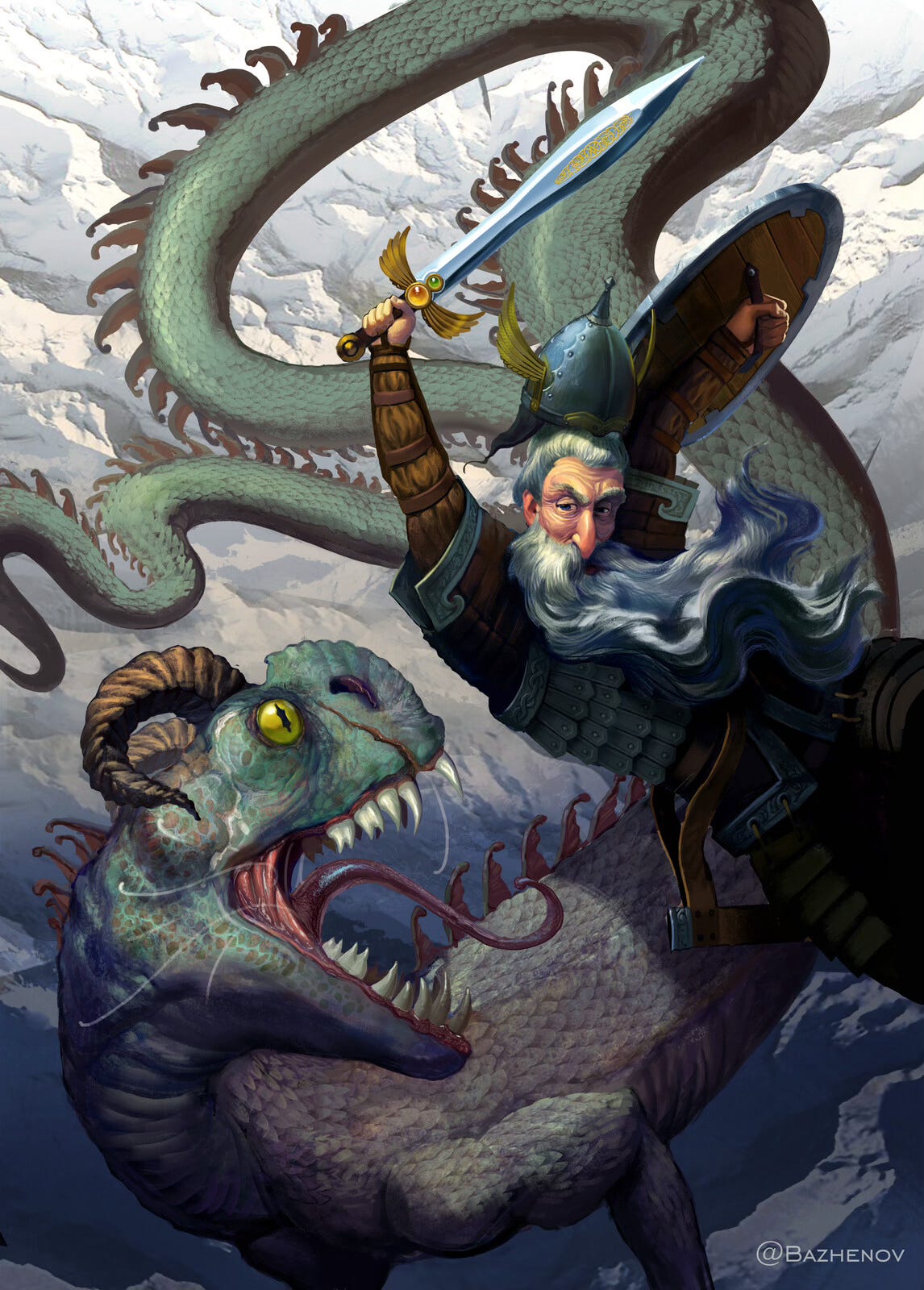
“Then Sigurd dug a trench in Fafnir’s(the brother turned dragon) path and got into it, and when Fafnir crawled down to the water and he passed over the trench, Sigurd thrust the sword through him, and this killed him.” -Edda (The Edda refers to two foundational collections of Old Norse literature)

“This book is called Edda. It was compiled by Snorri Sturluson in the manner in which it is arranged here. There is told first about the sir and Ymir, then Skaldskaparmal [the language of poetry] and terms for many things, finally Hattatal [list of verse-forms] which Snorri has composed about King Hakon and Duke Skuli” -Uppsala manuscript (a medieval Icelandic parchment codex from c. 1300–1325, held in Uppsala University Library, Sweden. It preserves one of the earliest (likely the oldest surviving) versions of Snorri Sturluson’s Prose Edda, uniquely titled “Edda”)
Snorri Sturluson (1179–1241) was a prominent Icelandic chieftain, poet, historian, and politician. A devout Christian writing in the 13th century (over 200 years after Iceland’s conversion around 1000 AD), he authored the Prose Edda—our main source for Norse mythology—and Heimskringla, a history of Norwegian kings. He likely also influenced Egils saga. Raised in a learned Christian environment and trained partly by clerics, Snorri preserved pagan myths and skaldic poetry.
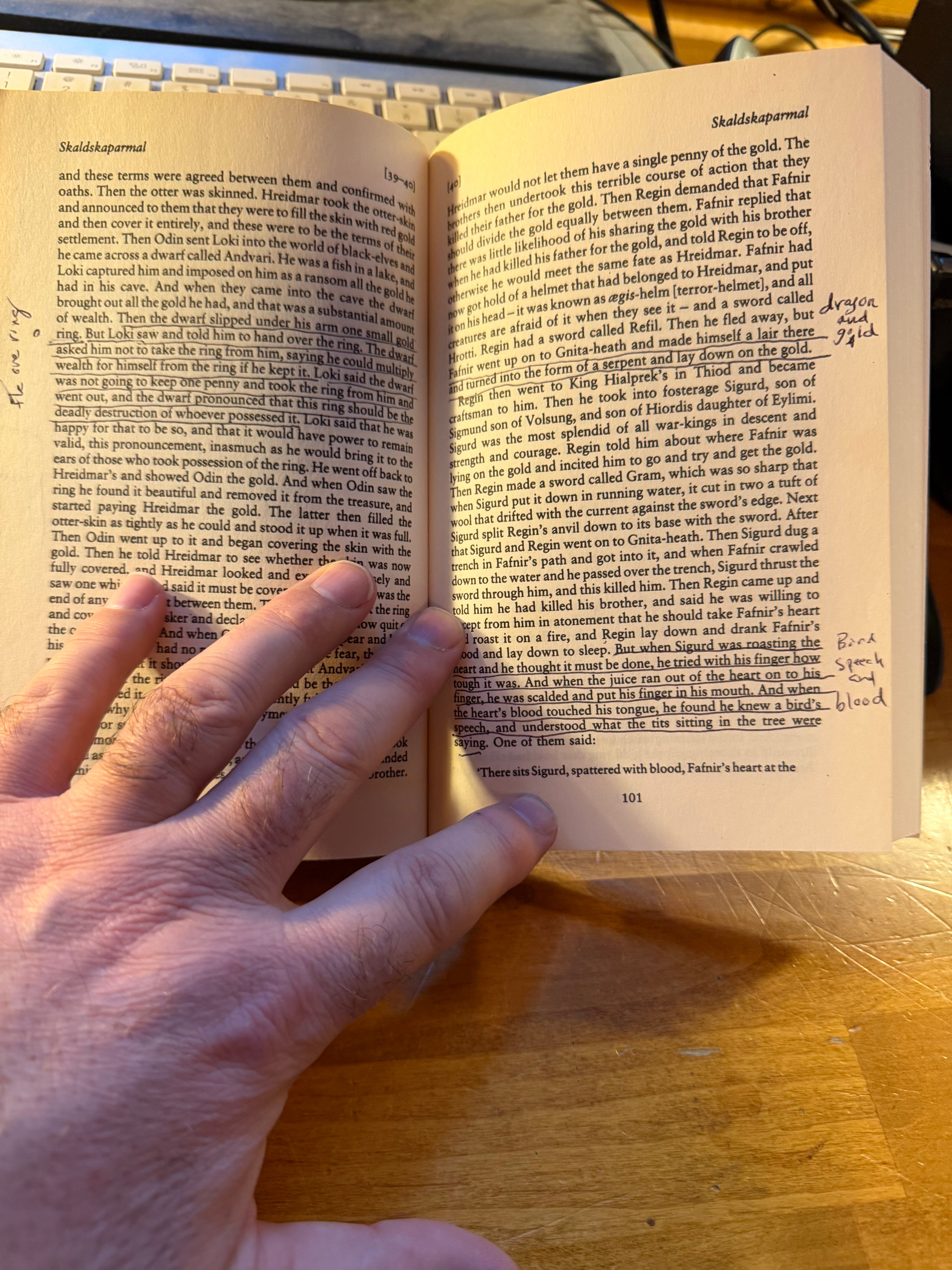
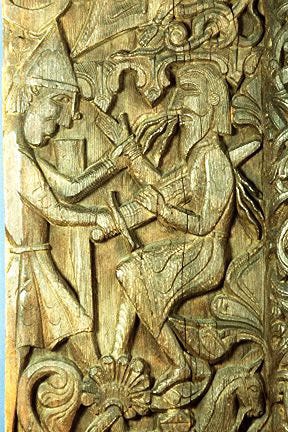
“Then Regin came up and told him he had killed his brother, and said he was willing to accept from him in atonement that he should take Fafnir’s heart and roast it on a fire, and Regin lay down and drank Fafnir’s blood* and lay down to sleep.
But when Sigurd was roasting the heart and he thought it must be done, he tried with his finger how tough it was. And when the juice ran out of the heart onto his finger, he was scalded and put his finger in his mouth. And when the heart’s blood touched his tongue, he found he knew a bird’s speech, and understood what the tits(nuthatches) sitting in the tree were saying:
“Fire he roasts, wise I would consider the ring-spoiler [generous man] if he ate the shining life-steak [heart].”
“There lies Regin,’ said another, ‘planning with himself, intending to trick the boy who trusts him. In his wrath he composes crooked speeches. The maker of mischiefs intends to avenge his brother.”
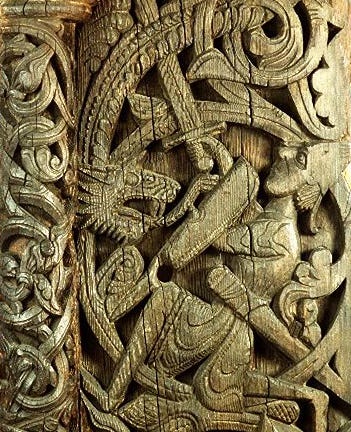
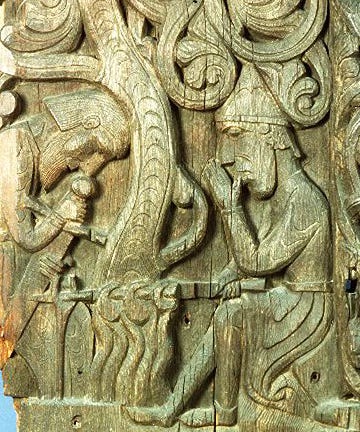
“Then Sigurd went up to Regin and killed him, and then to his horse, whose name was Grani, and rode it until he came to Fafnir’s lair. Then he picked up the gold and tied it in packs and put them up on Grani’s back, and climbed on himself and rode on his way.”
Matthew 4:1-2 “Then Jesus was led by the Spirit into the wilderness to be tempted by the devil. After fasting forty days and forty nights, he was hungry.”
There’s always a dragon in every story. Sometimes a literal one or it’s the dragon heart that pumps its bloody influence through the dark narrative in some fashion or another.
In the ancient world there was a belief that if you ate the flesh or drank the blood of your conquered foe, you would take on their power, strength or wisdom. What you defeat becomes part of you in some significant or meaningful way.
It wasn’t a guarantee as in Regins case, the old gods were mysterious tricksters and fate’s web often produced a spider that consumed you instead of blessing you. Luckily for Sigurd he gained the ability to understand bird speech and learned from them that he was in dire danger and had to act.
These Norse tales nourished the roots of J.R.R. Tolkien and C.S. Lewis’s story telling minds and hearts. Little Birds giving important life saving and dragon slaying messages to the Dwarves and to Bard of Laketown being one example.
“Stand by the grey stone when the thrush knocks, and the setting sun with the last light of Durin’s Day will shine upon the key-hole.” -This is the core inscription on the map, read aloud by Elrond. Chapters 11 and 12 in The Hobbit).
(To Bard:) “The moon is rising. Look for the hollow of the left breast as he flies and turns above you!”
If you’re like me these little snippets of story will find their way into my conversations with my grandchildren when we watch the forest birds flitting about our home and feeders. Yet, these tales are for more than interesting and joyful entertainment, they can shape and sharpen our discernment of the various events unfolding all around us.
We will encounter dragons and enemies seeking to “steal, kill and destroy” (John 10:10). We have been instructed to be prepared offensively and defensively against the attacks of devils: “Put on the whole armor of God, that you may be able to stand against the schemes of the devil.”
“Schemes” (Greek: methodeias) implies strategies, deception, or tactics — not just obvious attacks but subtle ones. You may be fighting a brother or sister that has become a dragon like Fafnir did. These are profoundly difficult moments in our lives. Now is the hour to dig your trenches like Sigurd did.
As Christian’s we have the holy flesh and blood of our Savior to eat and drink at the sacred table at the center of our worship. Our union with our Lord is the origin of all our victories: “In Him we live and move and have our being” Acts 17:2
I’m digging trenches, fighting dragons, roasting hearts, sipping blood, listening to the birds all about me helping me navigate the perils and opportunities of my day.
Fill your bags today with the gold found in Scripture and stories for our Lord has struck the ancient father of all dragons, a deadly blow.