
Regarding the Eucharist

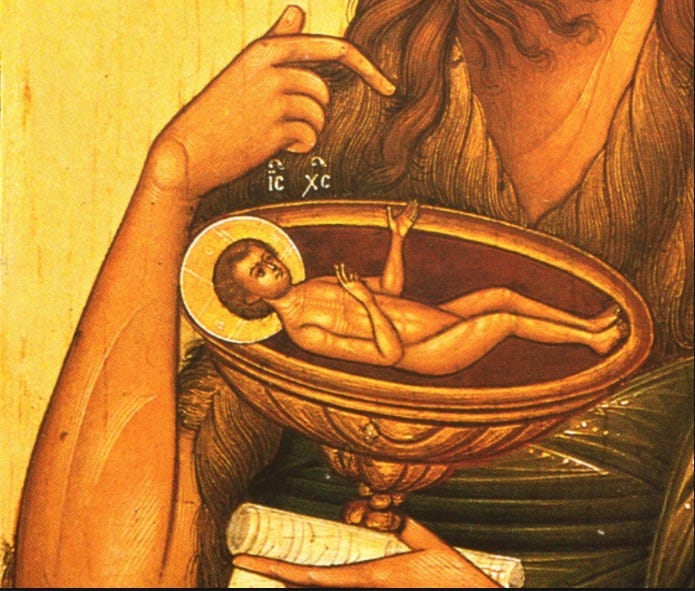
As I’m teaching through Revelation I’ve been revisiting the gift of the Eucharist in worship.
“Then I saw one like a slaughtered lamb standing in the midst of the throne and the four living creatures and among the elders. He had seven horns and seven eyes, which are the seven spirits of God sent into all the earth.” Revelation 5:6
John’s vision of Heavenly worship is packed with Old and New Covenant sign and symbol. The powerful imagery of the Passover/Eucharist slaughtered lamb at the center of it is particularly profound to contemplate.
If your new to the Christian faith you’ll soon discover that there’s quite a bit of church history drama and debate about this subject. Many Christian traditions demand one view or the other and it has become a deep dividing line.
I’m amazed and edified by the Protestant reformer Martin Luther’s ability to bring clarity to complex issues but also to call for freedom for those who differ in their own understanding of faith.
In this section of ‘The Pagan Servitude of the Church’ he’s debating the issue of the Eucharist and the Roman Catholic Church view of transubstantiation.
“I would therefore allow anyone to hold whichever opinion he prefers. The only thing I aim at for the present is to banish scruples of conscience, so that no one may fear being called a heretic if he believes that the bread and wine on the altar are real bread and wine. Let him understand that, without endangering his soul's salvation, he may believe and think and opine either the one or the other, because no particular view is a necessary article of the faith.”
“I rejoice to think that, at least among the ordinary people, simple faith in this sacrament still abides. Because they do not understand the dispute, they do not argue whether the accidents are there without the substance; rather, they believe, in simple faith, that the body and blood of Christ are truly contained there, and they leave the business of arguing what contains them to those who have time to spare.”
“The authority of the word of God goes beyond the capacity of our mind. Thus, in order that the true body and the true blood should be in the sacrament, the bread and wine have no need to be transubstantiated, and Christ contained under the accidents; but, while both remain the same, it would be true to say:
"This bread is my body, this wine is my blood", and conversely. That is how I would construe the words of divine Scripture and, at the same time, maintain due reverence for them. I cannot bear their being forced by human quibbles, and twisted into other meanings. Nevertheless, in my view, other men must be allowed another opinion, e.g., that laid down in the decretal Firmiter. But, as I have said, let them not press their opinions on us to be accepted as articles of faith.”
“Firstly, in order to be happy and assured, and to reach a true and unconstrained understanding of this sacrament, we must be careful to begin by setting aside all the later additions to the first, simple institution. Those additions have been made by men's devotion and through their zeal, and include such things as vestments, ornaments, chants, prayers, organs, candles, and the whole pageantry of things visible. Let us turn our eyes and devote our minds purely and simply to that alone which Christ Himself instituted. Let us confine ourselves to the very words by which Christ instituted and completed the sacrament, and commended it to us. For these words alone, and apart from everything else, contain the power, the nature, and the whole substance of the mass. All the rest are human productions, additions to the words of Christ, things without which the mass could still continue, and remain at its best.”
In debating other Protestant leaders and their views, Luther's response to Ulrich Zwingli is particularly generous even when they were unable to agree on the Eucharist.
Martin Luther believed in the Real Presence of Christ in the Mass versus Ulrich Zwingli's ‘symbolic memorial’ representation.
"Although we are not at this time agreed, as to whether the true Body and Blood of Christ are bodily present in the bread and wine, nevertheless the one party should show to the other Christian love, so far as conscience can permit, and both should fervently pray God Almighty, that, by His Spirit, He would confirm us in the true understanding.